Case Study
Helium Operations.
20% of global supply.
Every ISO container and every custody transfer, tracked across the largest helium distribution network in the world.
01 — The Operation
Industrial gas at global scale
Helium is a non-renewable byproduct of natural gas processing. The supply chain spans extraction, purification, distribution hubs, and end customers across multiple continents. This operation manages roughly 20% of the world's supply.
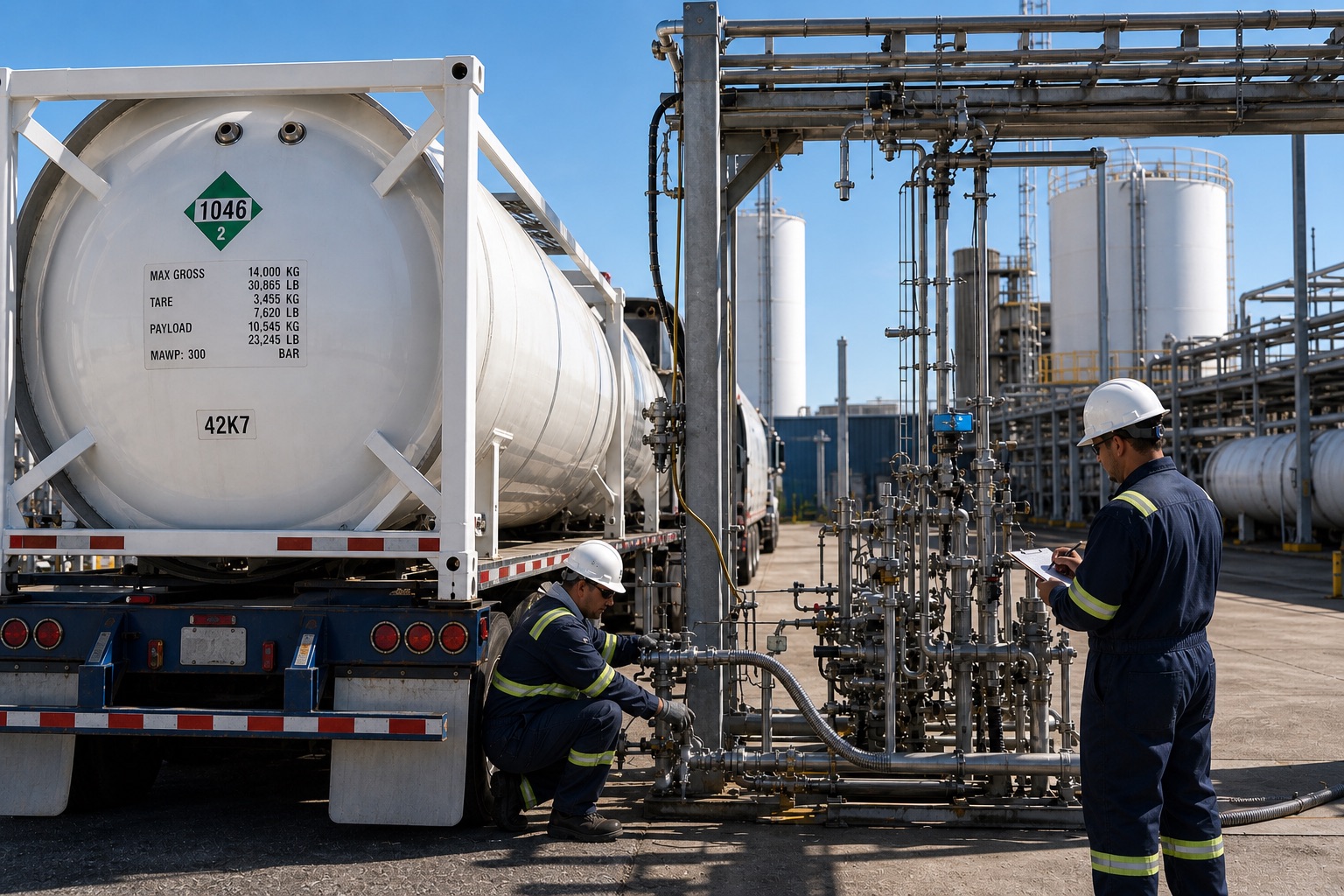
Every container — mostly cryogenic liquid-helium ISOs, some compressed-gas tube trailers — passes through multiple operators, carriers, and facilities. Each transfer needs documentation, measurement reconciliation, and compliance tracking. One misplaced container or unreconciled delivery can mean six-figure exposure.
02 — The Problem
Spreadsheets don't scale to 20% of global supply
The operation ran on spreadsheets, email chains, and manual reconciliation. Every custody transfer took phone calls to confirm receipt. Every invoice meant cross-referencing delivery tickets against purchase orders against plant meter readings. Month-end reconciliation took days — sometimes weeks — tracing discrepancies through paper trails and email threads.
Worse was visibility. Plant managers couldn't answer basic questions in real time: Where are our containers? Which deliveries are unreconciled? What is our inventory position right now? The answers were scattered across people, inboxes, and stale spreadsheets.
Off-the-shelf ERP was evaluated and rejected. Modeling helium primitives — ISO container types, purity grades, custody chain requirements, plant-specific measurement protocols — meant months of customization, ending in a custom system on a foundation that fights you.
03 — The Constellations
Four patterns, one coherent system
01
Asset Tracking
Every ISO container modeled with location, custody state, purity grade, pressure readings, and maintenance history. Real-time fleet visibility, not yesterday's report.
02
Transaction Management
Custody transfers, invoicing, and multi-party reconciliation. Every delivery is an auditable transaction with measurement data, timestamps, and participant confirmation.
03
Data Modeling
Container types, purity grades, facility configurations, carrier relationships, pricing structures. The system speaks the operation's language, not ERP vocabulary.
04
Identity & Access
Multi-tenant isolation between operators, carriers, and facility managers. Each sees their own containers, deliveries, and reconciliation status — nothing competitive.
04 — The Result
$50M projected value. From days to minutes.
The projected ROI on this deployment is $50 million over ten years — a 10x return on the system investment. Month-end reconciliation dropped from days to minutes. Every custody transfer is recorded as it happens, with measurement data attached, so discrepancies show up in the record rather than three weeks later at close.
Plant managers answer “where are our containers?” in real time, from any device. Transactions are auditable, and the data compliance needs is already in the system.

See how this applies to your operation.
If you manage physical assets across a distributed supply chain, the same patterns can model your operation.